


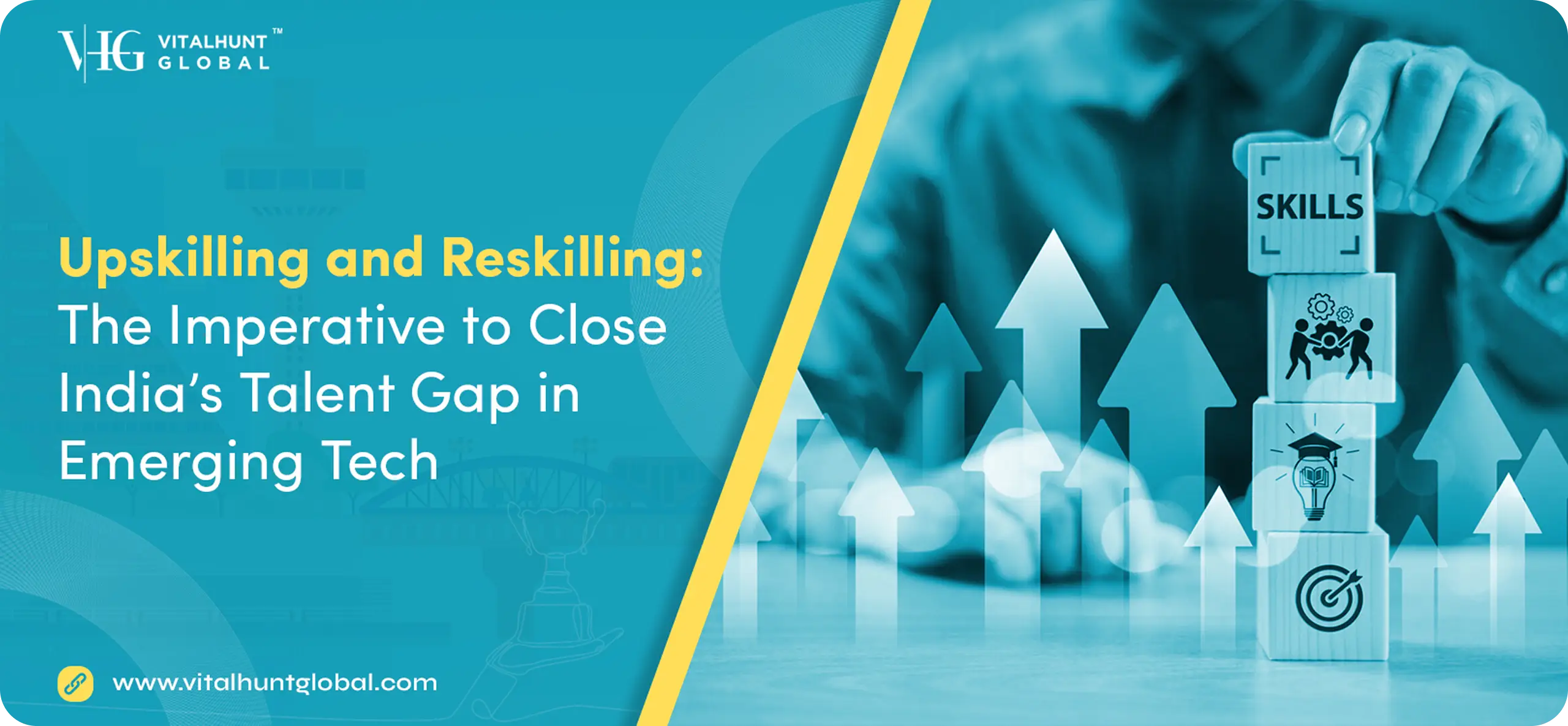
Upskilling and Reskilling: The Imperative to Close India's Talent Gap in Emerging Tech

Hiring 15 December, 2025
Something interesting is happening across companies right now.
Not loudly. Not dramatically.
But consistently.
Teams are growing. Technology is evolving.
And somewhere in between… a gap is quietly appearing.
Not a hiring gap.
A skills gap.
You might already be seeing it.
A role opens up.
Candidates apply.
Experience looks good… but something feels missing.
Not because people aren't capable.
But because the world of work is moving faster than traditional learning.
And that's where upskilling and reskilling in India step in—not as a trend, but as a necessity.
It's Not Just Hiring Anymore. It's Evolving Talent
For a long time, businesses believed growth comes from hiring better people.
Now, there's a shift.
Growth comes from growing your people.
Because even the best hires need to adapt.
Especially in areas like:
- AI in India workforce
- Cloud computing
- Cybersecurity
- Data analytics
These aren't static skills. They evolve. Constantly.
So companies that invest in workforce upskilling strategies aren't just filling roles…
They're future-proofing their teams.
Why Upskilling Has Become a Strategic HR Priority
Let's look at this from a simple lens.
Imagine two companies:
One keeps hiring externally for every new skill.
The other develops those skills internally.
Over time… who becomes more stable?
Who builds stronger teams?
Who retains talent better?
The answer is quite clear.
That's why today, HR is not just about hiring.
It's about capability building.
A strong HR strategy in India now includes:
- Continuous learning systems
- Skill gap identification
- Internal mobility planning
- Long-term workforce development
Because when people grow… businesses grow with them.
The Shift from Learning to Smart Learning
Now here's where things get even more interesting.
Learning itself has changed.
It's no longer about long training sessions or static modules.
Today's workforce prefers learning that is:
- Quick
- Flexible
- Engaging
- Practical
And that's exactly why modern companies are exploring:
Mobile Learning
Learning on the go. Short modules. Easy access. Employees don't need to pause work for learning… They integrate it into their day.
Gamification in Training
Adding a bit of challenge. Progress tracking. Rewards. It makes learning feel less like a task… and more like an experience. And surprisingly, it improves retention too.
VR-Based Learning
This is where things feel futuristic. Using virtual environments to simulate real-world scenarios. Especially useful for: • Technical training • Safety simulations • Complex problem-solving It's immersive. And it works.
The Skills That Are Actually Driving Demand
Now let's talk specifics.
Because while learning is important… what you learn matters even more.
Across industries, there's clear demand for:
Artificial Intelligence (AI)
From automation to decision-making, AI is everywhere. Companies need professionals who understand not just tools… but logic behind them.
Cloud Computing
As businesses move digital, cloud infrastructure becomes the backbone. Skills in AWS, Azure, and cloud management are highly valuable.
Cybersecurity
With digital growth comes digital risk. Organizations are actively investing in professionals who can protect systems and data.
Data & Analytics
Data is no longer optional. Understanding data… interpreting it… using it for decisions—that's a powerful skill set.
These are not "nice-to-have" skills anymore.
They're becoming essential.
And companies investing in reskilling programs in India are already ahead of the curve.
A Small Shift That Creates Big Impact
Sometimes, the biggest changes don't come from big actions.
Just a shift in approach.
Instead of asking:
"Who can we hire for this role?"
Ask:
"Who in our team can grow into this role?"
That one question changes everything.
It builds:
- Loyalty
- Confidence
- Long-term capability
And honestly… it feels better too.
Because people don't just want jobs anymore.
They want growth.
How Organizations Can Start (Without Overcomplicating It)
You don't need a massive transformation to begin.
Start simple.
- Identify current skill gaps
- Introduce short learning modules
- Encourage cross-functional exposure
- Invest in digital learning tools
- Track progress (even basic tracking helps)
Over time, these small steps create a strong learning culture.
And culture… is what sustains growth.
The Real Advantage Isn't Technology. It's Adaptability
Technology will keep changing. That's certain.
But the real strength of an organization lies in how quickly its people can adapt.
Companies that invest in:
- Upskilling and reskilling in India
- Modern learning platforms
- Continuous development systems
don't just keep up.
They lead.
Quietly. Consistently.
Final Thoughts: Growth That Feels Sustainable
At the end of the day, this isn't just about skills.
It's about confidence.
When employees feel:
- Capable
- Supported
- Future-ready
They perform differently.
They think bigger. Contribute more.
And that's where real transformation begins.
Not from outside hiring.
But from inside growth.
Let's Build Skills That Grow With Your Business
If you're thinking about strengthening your team for the future… this is a great place to begin.
Start small. Stay consistent.
Whether it's building workforce upskilling strategies, exploring modern learning tools, or designing structured reskilling programs in India…
The right approach can make your team more adaptable, more confident, and more ready for what's next.
Because when your people grow, your business naturally moves forward with them.
Similar Blogs
Hiring12 September, 2024
Talent Architecture: Designing Workforce Systems for Sustainable Organizational Success
Growth looks different from the inside. From the outside, it often seems smooth. Teams expanding. New clients coming in...
Hiring28 September, 2024
The Talent Lifecycle Framework: From Attraction to Retention
Some things in business feel exciting right away. Hiring someone new… is one of them. But truth is… hiring is just the beginning...
Let's Build
What's Next.
Whether you are looking for a critical leader, building a new team, scaling your workforce or strengthening your HR function, let's start with a conversation.
Tell us what you are building. We'll help you find the people and solutions to move it forward.